
In the world of piping and pipeline engineering, few terms are as frequently used—and as often misunderstood—as Nominal Pipe Size (NPS). Whether you’re working in oil and gas, chemical plants, petrochemical systems, HVAC systems, or even water distribution networks, NPS is a fundamental concept that quietly governs how pipes are selected, connected, and standardized across industries.
Despite its importance, many beginners assume NPS directly refers to the actual physical size of a pipe. In reality, it is more of a standardized reference system than a true measurement. Understanding it properly can save engineers from costly design errors, mismatched fittings, and confusion during fabrication or procurement.
This article breaks down NPS in a simple, engaging, and practical way so you can confidently interpret pipe specifications in real-world applications.
What is Nominal Pipe Size (NPS)?
Nominal Pipe Size (NPS) is a North American standard used to define the size of pipes used in various industries, particularly in piping systems.
However, the key point to understand is:
NPS is not the actual measured diameter of the pipe. It is a nominal (name-only) designation.
Instead of representing exact dimensions, NPS acts as a labeling system that corresponds to a range of standard pipe sizes. The actual dimensions depend on two things:
- The NPS number
- The pipe schedule (wall thickness)
Together, these define the real outside diameter (OD) and inside diameter (ID) of a pipe.
Why is it called “Nominal”?
The word “nominal” means “in name only.”
Historically, pipe sizes were based on the approximate inside diameter (ID) of the pipe when wall thickness was relatively uniform. However, as engineering evolved and different pressure requirements emerged, pipe wall thicknesses increased while keeping the outside diameter standardized.
As a result:
- The name (NPS) stayed the same
- The actual internal diameter changed depending on wall thickness (schedule)
So today, NPS is essentially a standard reference label, not a direct measurement.
Understanding the Structure of NPS
NPS is expressed in two ways:
1. Small pipe sizes (NPS 1/8 to NPS 12)
These are often shown in fractional or whole numbers:
- NPS 1/2
- NPS 1
- NPS 6
- NPS 12
For these sizes, the outside diameter does NOT match the NPS number.
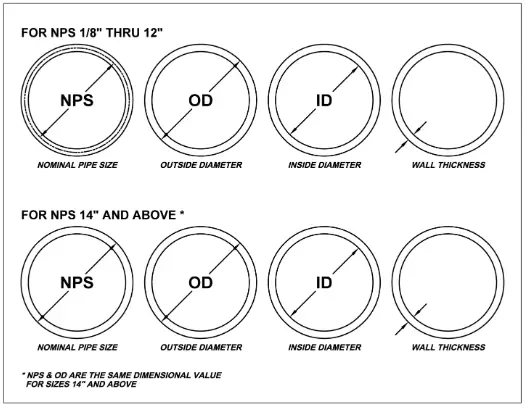
2. Large pipe sizes (NPS 14 and above)
For larger pipes:
- NPS number is generally equal to the outside diameter in inches
Example:
- NPS 14 ≈ 14-inch OD
- NPS 24 ≈ 24-inch OD
Even here, the inside diameter still depends on wall thickness.
NPS vs Actual Pipe Dimensions
One of the biggest misconceptions is assuming that:
NPS = Pipe diameter
But in reality, pipe dimensions are defined by:
Outside Diameter (OD)
- Fixed for each NPS size
- Does not change with the schedule
Wall Thickness (Schedule)
- Determines pipe strength
- Examples: Schedule 40, Schedule 80, Schedule 160
Inside Diameter (ID)
- Varies depending on wall thickness
- Higher schedule = thicker wall = smaller ID
For example:
An NPS 2 pipe has:
- Constant OD: 2.375 inches
But: - Schedule 40 → larger ID
- Schedule 80 → smaller ID
This is why engineers must always check both NPS and schedule together.
What is Pipe Schedule and Why Does It Matter?
To fully understand NPS, you must also understand pipe schedule.
Pipe schedule defines the wall thickness of the pipe, which determines:
- Pressure handling capacity
- Flow characteristics
- Structural strength
Common schedules include:
- Schedule 10 (light duty)
- Schedule 40 (standard duty)
- Schedule 80 (heavy duty)
- Schedule 160 (very heavy duty)
Even though two pipes may share the same NPS, their performance can be completely different due to schedule variations.
Relationship Between NPS and DN (Metric System)
Outside North America, piping systems often use DN (Diameter Nominal), which is part of the metric system.
Key difference:
- NPS → inches-based system (US standard)
- DN → millimeter-based system (ISO/metric standard)
Approximate conversions:
- NPS 1/2 = DN 15
- NPS 1 = DN 25
- NPS 2 = DN 50
- NPS 4 = DN 100
However, like NPS, DN is also nominal—not exact.
Why NPS Does Not Match Actual Pipe Size
The reason NPS does not equal real pipe dimensions lies in historical standardization.
Originally:
- Pipe size referred to the approximate internal flow capacity
But over time:
- Pressure demands increased
- Pipe walls became thicker
- OD remained standardized for compatibility with fittings
This ensured that:
- Flanges still fit
- Fittings remain interchangeable
- System design stays consistent globally
So instead of changing the external size, engineers adjusted wall thickness and retained NPS labels.
Importance of NPS in Engineering Design
Understanding NPS is critical in engineering because it affects:
1. Equipment Compatibility
Valves, flanges, reducers, and fittings must match NPS exactly.
2. Flow Calculations
Since ID varies with schedule, flow rate, and velocity calculations depend on correct sizing.
3. Pressure Design
Thicker schedules are selected based on operating pressure, temperature, and safety margins.
4. Procurement and Fabrication
Incorrect NPS selection can lead to mismatched components and costly delays.
Common Mistakes Engineers Make with NPS
Even experienced professionals sometimes make errors with NPS. Some common mistakes include:
1. Assuming NPS equals actual diameter
This is the most frequent misunderstanding.
2. Ignoring pipe schedule
Two pipes with the same NPS can behave completely differently.
3. Mixing NPS and DN without conversion
This leads to mismatched components in international projects.
4. Using OD instead of ID for flow calculations
Flow capacity depends on internal diameter, not external size.
Real-World Example of NPS Application
Imagine a chemical plant requires a pipeline for transporting steam:
- Engineers select NPS 4 pipe
- Operating pressure is high → they choose Schedule 80
Now:
- OD remains fixed (for fittings compatibility)
- Wall thickness increases for safety
- ID decreases, slightly affecting the flow rate
Without understanding NPS and the schedule together, this design could easily fail under pressure conditions or cause incorrect flow estimations.
Advantages of Using the NPS Standard
The NPS system provides several key benefits:
1. Standardization
Ensures all manufacturers follow a universal size system.
2. Interchangeability
Pipes, valves, and fittings can be mixed across vendors.
3. Simplified Engineering
Engineers can design systems without needing custom dimensions for every component.
4. Global Industry Acceptance
NPS is widely used in oil & gas, petrochemical, and power industries.
Future of Pipe Sizing Systems
While NPS remains dominant in many industries, global engineering is gradually moving toward unified digital standards and hybrid systems combining:
- NPS (imperial systems)
- DN (metric systems)
- Digital pipe specification databases (BIM systems)
This evolution aims to reduce confusion and improve accuracy in complex industrial projects.
Conclusion
Nominal Pipe Size (NPS) is far more than just a number printed on a pipe. It is a standardized labeling system that ensures compatibility, consistency, and reliability across global piping systems.
However, its “nominal” nature means it should never be used in isolation. Engineers must always consider:
- Pipe schedule
- Outside diameter
- Inside diameter
- Operating conditions
Once you understand NPS properly, piping specifications become far less confusing and much more intuitive. It is truly the hidden language that keeps modern industrial systems connected and functioning safely.