
Walk through any industrial plant—oil & gas, chemical, power generation, or water treatment—and you’ll notice something interesting. Valves are everywhere. They regulate flow, control pressure, and ensure systems operate safely. But what most people overlook are the small markings stamped on their bodies.
At first glance, these markings may look like random codes, numbers, and abbreviations. In reality, they are a compact technical identity card for the valve. Once you understand how to read them, you can instantly learn a valve’s size, pressure limits, material, origin, and even installation direction.
The good news? You don’t need to be a seasoned engineer to decode them.
Let’s break it down in a simple, practical way.
Why Valve Markings Matter
Valve markings are not decorative—they are essential for:
- Safe installation and operation
- Correct selection for process conditions
- Maintenance and replacement decisions
- Compliance with engineering standards
- Preventing costly system failures
In industrial environments where pressure, temperature, and fluid types vary widely, choosing the wrong valve can lead to leaks, breakdowns, or even catastrophic failures. These markings eliminate guesswork.
Think of them as the valve’s passport—containing everything you need to know at a glance.
The Language of Valve Markings Explained
Valve markings typically follow international standards such as ASME, API, and ISO. While formats can vary slightly by manufacturer, the core information remains consistent.
Let’s decode the most important elements.
1. Valve Size (NPS – Nominal Pipe Size)
One of the first markings you will notice is the valve size.
For example: NPS 3”
This simply means the valve is designed to fit a 3-inch nominal pipe size.
However, it’s important to note that NPS is not always the exact internal diameter. Instead, it is a standardized reference used across piping systems to ensure compatibility.
✔ Why it matters:
- Ensures correct pipe-to-valve matching
- Prevents installation mismatches
- Maintains system flow efficiency
2. Pressure Class (ASME Class Rating)
Example: ASME Class 600
This is one of the most critical markings on a valve. It indicates how much pressure the valve can safely handle at a given temperature.
In simple terms:
- Higher class = stronger valve = higher pressure capacity
Typical classes include:
- Class 150
- Class 300
- Class 600
- Class 900 and above
✔ Why it matters:
- Prevents pressure failure
- Ensures safe operation in high-pressure systems
- Helps engineers select the right valve for process conditions
Using a lower-class valve in a high-pressure system can result in leaks or rupture, making this marking extremely important.
3. Material Identification (e.g., CF8M)
Example: CF8M
This marking tells you what the valve is made of. CF8M is a common stainless steel grade equivalent to AISI 316.
It is widely used because it offers:
- Excellent corrosion resistance
- Good mechanical strength
- Suitability for harsh environments
Other common materials include carbon steel, alloy steel, and duplex stainless steels.
✔ Why it matters:
- Determines compatibility with fluids (water, oil, chemicals, gas)
- Impacts durability and lifespan
- Helps prevent corrosion-related failures
Choosing the wrong material can quickly lead to degradation and costly replacements.
4. Manufacturer Identification
Every valve carries the name or logo of its manufacturer.
This is not just branding—it serves a technical purpose.
✔ Why it matters:
- Ensures traceability
- Helps in sourcing spare parts
- Confirms compliance with quality standards
- Assists in audits and certifications
In critical industries like oil & gas, knowing the manufacturer is essential for maintaining approved vendor lists and ensuring reliability.
5. Flow Direction Arrow ➡️
Some valves, especially check valves and control valves, include a flow direction arrow.
This arrow indicates how the fluid should pass through the valve.
✔ Why it matters:
- Ensures correct installation
- Prevents reverse flow issues
- Avoids mechanical damage or system failure
Installing a directional valve backward can completely disrupt system performance or damage internal components.
This is one of the simplest markings—but also one of the most ignored mistakes in field installation.
6. Heat Number / Traceability Code
This is a unique alphanumeric code stamped on the valve body.
It allows engineers and inspectors to trace the valve back to its original manufacturing batch.
✔ Why it matters:
- Provides full material traceability
- Supports quality assurance processes
- Helps identify defects or recalls
- Required for many industrial certifications
Think of it as the valve’s DNA code. If anything goes wrong, this number helps track its entire production history.
Rewriting the Valve Markings Guide (Simple Breakdown for Easy Understanding) with an Example
To make things even clearer, here’s a simplified explanation of valve markings in everyday language:
How to Read Valve Markings
You don’t need to be an engineer to understand what’s written on an industrial valve.
Those small markings are like an ID card for the valve—they tell you everything important in seconds.
Here’s a simple breakdown 👇. Refer to the attached image in Fig. 1 below:
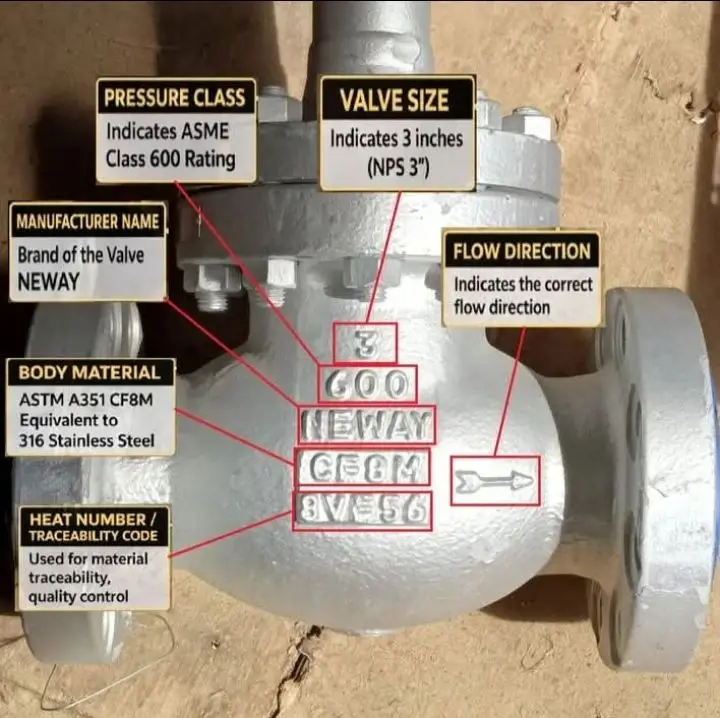
1️⃣ Valve Size (NPS 3”)
This tells you the pipe size the valve is designed for.
Example: NPS 3” = fits a 3-inch pipe
It ensures the valve matches the pipeline correctly.
2️⃣ Pressure Class (ASME Class 600)
This shows how much pressure the valve can safely handle.
- Higher class = higher pressure capability
- Essential for safe operation in demanding systems
3️⃣ Material (CF8M)
CF8M refers to stainless steel similar to AISI 316.
It is commonly used because:
- It resists corrosion
- It performs well in harsh environments
- It has a long service life
4️⃣ Manufacturer Name
The brand stamped on the valve identifies who made it.
This is important for:
- Quality assurance
- Spare parts availability
- Compliance and approvals
5️⃣ Flow Direction Arrow ➡️
This arrow shows the correct direction of fluid flow.
Installing the valve the wrong way can lead to:
- Poor performance
- Equipment damage
- System failure
6️⃣ Heat Number / Traceability Code
This code allows full tracking of the valve back to the factory batch.
It is crucial for:
- Quality control
- Safety verification
- Material certification
Why This Matters
Understanding valve markings helps you:
- Avoid installation mistakes
- Choose the right valve for the job
- Improve system safety and reliability
- Save time and reduce costs
Engineering doesn’t have to be complicated—it’s just information made simple.
Common Mistakes People Make When Reading Valve Markings
Even experienced technicians sometimes overlook key details. Here are some common errors:
- Ignoring the pressure class and assuming all valves are interchangeable
- Installing directional valves backward
- Overlooking material compatibility with fluids
- Failing to verify traceability codes
- Confusing nominal size with actual bore size
Avoiding these mistakes can significantly improve system performance and safety.
Small Markings, Big Responsibility
Valve markings may look like a mix of codes and abbreviations, but they carry critical engineering information. Once you understand them, you gain the ability to quickly assess whether a valve is suitable for a specific application.
In industrial systems where precision and safety matter, these markings are not optional—they are essential.
The next time you see a valve, take a closer look. You’ll realize it is not just a mechanical component—it is a carefully documented piece of engineering designed for reliability, safety, and performance.