Engineering is not only a technical discipline; it is also a profession grounded in responsibility, accountability, and public trust. Every design decision, calculation, specification, and construction oversight made by an engineer has the potential to affect public safety, environmental well-being, and economic stability. For this reason, engineering ethics forms a critical foundation of professional practice.
While technical expertise ensures that engineers can solve complex problems, ethical judgment ensures that those solutions are applied responsibly and in the public interest. As engineering systems have grown more complex and interconnected, the importance of strong ethical standards has increased significantly.
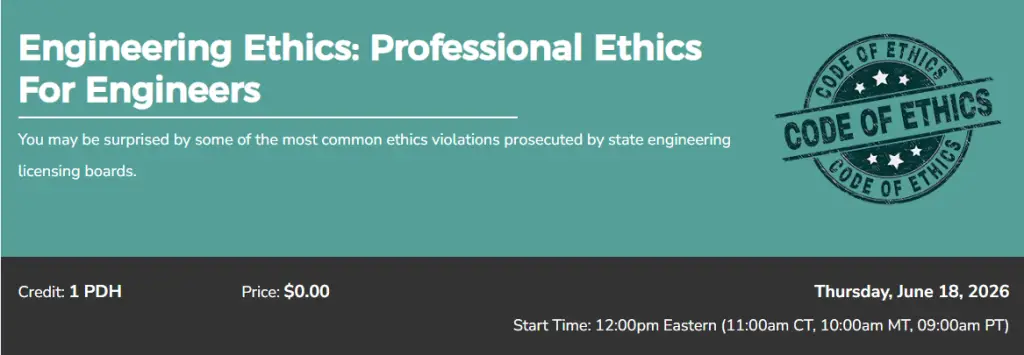
To explore these essential principles in depth, a free, one-hour professional webinar on Engineering Ethics has been organized. This session is designed to help engineers, students, and professionals understand the ethical responsibilities that guide the profession, while also providing insight into real-world violations and how to avoid them.
Webinar Overview: Understanding the Role of Ethics in Engineering Practice
The upcoming webinar, titled “Professional Ethics for Engineers,” offers a structured and practical discussion on the ethical expectations placed upon engineers in modern practice. It highlights the evolution of engineering ethics, the role of professional licensing boards, and the consequences of ethical violations.
Participants will gain a deeper understanding of how ethical frameworks are applied in real-world engineering environments, particularly in cases that have been reviewed and prosecuted by state licensing boards.
A key emphasis of the session is the practical application of ethical principles—helping professionals not only understand what the codes of ethics state, but also how to apply them effectively in everyday decision-making.
Historical Development of Engineering Ethics
Early Perspective: Ethics as Personal Responsibility
Prior to the 20th century, engineering ethics was largely considered a matter of individual moral responsibility. Professional societies generally believed that ethical behavior did not require formal codification. Instead, engineers were expected to rely on personal integrity and judgment when making professional decisions.
During this period, there were no standardized written codes of conduct governing engineering practice. As a result, expectations varied widely across individuals and organizations.
Emergence of Formal Codes in the Early 1900s
With the rapid expansion of industrialization and large-scale engineering projects in the early 1900s, the need for standardized ethical guidelines became increasingly evident. Engineering work began to have a much greater impact on public infrastructure, safety, and national development.
As a response, the first formal codes of engineering conduct were introduced. These early codes primarily emphasized:
- Loyalty to employers
- Professional competence
- Confidentiality in business relationships
At this stage, ethical responsibility was still largely viewed through the lens of employer-employee relationships rather than broader societal obligations.
Evolution Toward Public Responsibility
Mid-20th Century Shift in Ethical Thinking
A significant transformation in engineering ethics occurred during the mid-20th century. During this time, professional organizations began to recognize that engineers have a broader obligation—not only to employers but also to the public at large.
This shift reflected growing awareness that engineering decisions directly impact public safety, environmental protection, and societal welfare.
The NSPE Canon of Ethics
On October 28, 1946, the Board of Directors of the National Society of Professional Engineers (NSPE) formally adopted the “Canon of Ethics for Engineers.” This foundational document was developed by the Engineers’ Council for Professional Development (ECPD), which is now known as the Accreditation Board for Engineering and Technology (ABET).
This model introduced a more structured ethical framework that emphasized:
- Protection of public health, safety, and welfare
- Professional integrity and honesty
- Avoidance of deceptive practices
- Responsibility to act within areas of competence
Over time, this model evolved and became the foundation for modern engineering ethics codes adopted by state licensing boards across the United States and beyond.
Modern Engineering Ethics and Licensing Boards
Today, engineering ethics is not merely advisory—it is legally enforceable in many jurisdictions. State engineering licensing boards adopt codes of ethics that are based on the ECPD/ABET model, and violations can result in disciplinary action.
These boards are responsible for:
- Licensing professional engineers
- Monitoring professional conduct
- Investigating complaints and violations
- Enforcing disciplinary measures when necessary
Ethical violations can lead to serious consequences, including license suspension, revocation, financial penalties, and reputational damage.
Common Ethics Violations in Engineering Practice
One of the key focus areas of the webinar is the examination of real-world ethics violations that frequently appear in disciplinary cases reviewed by licensing boards.
1. Misrepresentation of Qualifications
One of the most common violations involves engineers misrepresenting their credentials, experience, or professional capabilities. This may include:
- Claiming expertise in areas outside one’s competence
- Exaggerating project experience
- Signing off on work not personally reviewed or supervised
Such actions undermine professional trust and can lead to unsafe engineering outcomes.
2. Negligence in Professional Duties
Negligence occurs when an engineer fails to exercise appropriate care in performing professional responsibilities. This may include:
- Inadequate design verification
- Failure to follow engineering standards
- Overlooking critical safety considerations
Negligence can have severe consequences, especially in high-risk industries such as construction, energy, and transportation.
3. Conflicts of Interest
Conflicts of interest arise when personal, financial, or professional interests interfere with an engineer’s duty to act objectively. These situations may lead to:
- Biased decision-making
- Preferential treatment of vendors or contractors
- Lack of transparency in project execution
Understanding how to identify and manage conflicts of interest is essential for maintaining ethical integrity.
4. Unauthorized Practice or Improper Supervision
Another common violation involves engineers signing off on work that has not been properly supervised or reviewed. This includes:
- Delegating responsibility without oversight
- Allowing unqualified individuals to perform engineering tasks
- Issuing approvals without adequate verification
Such practices can compromise project safety and quality.
Managing Conflicts of Interest in Engineering
Conflicts of interest are among the most challenging ethical issues engineers face in practice. They may not always be obvious and can arise in both public and private sector projects.
The webinar provides practical guidance on:
- Recognizing potential conflicts early
- Disclosing conflicts transparently
- Recusing oneself from decision-making when necessary
- Maintaining professional independence
Proper management of these conflicts is essential for preserving trust and ensuring unbiased engineering judgment.
Learning Through Real-World Case Studies
A key feature of the session is its discussion-based and case-study-driven format. Participants will be presented with real-life scenarios in which engineers faced ethical dilemmas during professional practice.
These case studies help illustrate:
- How ethical violations occur in practical settings
- The decision-making processes that lead to misconduct
- The consequences faced by professionals involved
- The lessons that can be learned to prevent similar situations
By analyzing these cases, participants develop a more practical understanding of how ethical principles apply in real engineering environments.
Importance of Engineering Ethics in Modern Practice
Engineering ethics is not merely a regulatory requirement—it is a fundamental component of professional identity. Ethical conduct ensures that engineering work contributes positively to society and maintains public confidence in the profession.
Studying and practicing engineering ethics is important because it:
- Protects public safety and welfare
- Ensures accountability in engineering decisions
- Enhances professional credibility and trust
- Reduces legal and regulatory risks
- Promotes long-term sustainability in engineering practice
In an era of rapid technological advancement, ethical decision-making has become more critical than ever.
Webinar Details and Schedule
This one-hour professional development webinar has been carefully designed to provide a concise yet comprehensive overview of engineering ethics.
Webinar Title:
Professional Ethics for Engineers
Date:
Thursday, June 18, 2026
Time:
12:00 PM Eastern Time (ET)
11:00 AM Central Time (CT)
10:00 AM Mountain Time (MT)
09:00 AM Pacific Time (PT)
The session will be led by an experienced engineering professional with extensive expertise in ethical standards and professional practice. Participants will benefit from practical insights and real-world examples drawn from professional engineering environments.
What You Will Learn
In just one hour, participants will gain valuable knowledge on several key aspects of engineering ethics, including:
- A concise overview of the historical development of engineering ethics
- An understanding of the National Society of Professional Engineers (NSPE) Code of Ethics
- Insights into the most common ethics violations and their consequences
- Practical strategies for identifying and avoiding conflicts of interest
- The importance of ethical awareness in professional engineering practice
These learning outcomes are designed to strengthen both technical professionals and students in their understanding of responsible engineering conduct.
Register for the Webinar
Professionals, students, and engineering practitioners who wish to strengthen their understanding of ethical responsibility in engineering are encouraged to attend this informative session.
To register for the webinar, please visit the link below:
👉 https://noonpi.com/register-free-webinar/?webinar=NP-F-1039W
Final Thoughts
Engineering ethics serves as the moral foundation of the profession, guiding engineers in making decisions that impact society, infrastructure, and the environment. As engineering systems continue to grow in complexity, the importance of ethical awareness becomes increasingly significant.
This webinar offers a valuable opportunity to revisit core ethical principles, examine real-world violations, and strengthen professional judgment. By engaging with these concepts, engineers can better ensure that their work not only meets technical standards but also upholds the highest levels of integrity and public trust.