
When engineers, fabricators, contractors, and piping professionals talk about a 6-inch pipe, NPS 10 pipe, Schedule 40, or DN 250, they are not necessarily describing the pipe’s actual inside or outside diameter. This is one of the most important—and frequently misunderstood—concepts in industrial piping.
The Nominal Pipe Size (NPS) system provides a standardized way to identify pipe sizes, while the pipe schedule indicates wall thickness. Together, these designations help engineers select, specify, manufacture, connect, and maintain piping systems used in industries ranging from oil and gas to chemical processing, power generation, water treatment, and manufacturing.
Basically, NPS is a dimensionless designation for standardized pipe size, with its origins tracing back to the older Iron Pipe Size (IPS) system. Importantly, the NPS number should not automatically be interpreted as the pipe’s actual inside diameter.
In this guide, we will explore what NPS means, how pipe schedules work, why actual pipe dimensions differ from nominal sizes, how NPS relates to DN, and what engineers should know when selecting pipe dimensions.
What Is Nominal Pipe Size (NPS)?
Nominal Pipe Size (NPS) is a standardized, dimensionless designation used primarily in North America to identify pipe sizes.
For example, a pipe may be specified as:
- NPS 1
- NPS 2
- NPS 4
- NPS 6
- NPS 10
- NPS 12
- NPS 24
The critical point is that NPS is a nominal designation, not a direct measurement of the pipe’s inside diameter.
For instance, an NPS 6 pipe has an actual outside diameter of 168.3 mm, rather than an outside diameter of exactly six inches. For NPS sizes up to and including 12, the actual outside diameter is generally larger than the nominal designation. Beginning at NPS 14, the nominal designation corresponds much more closely to the actual outside diameter.
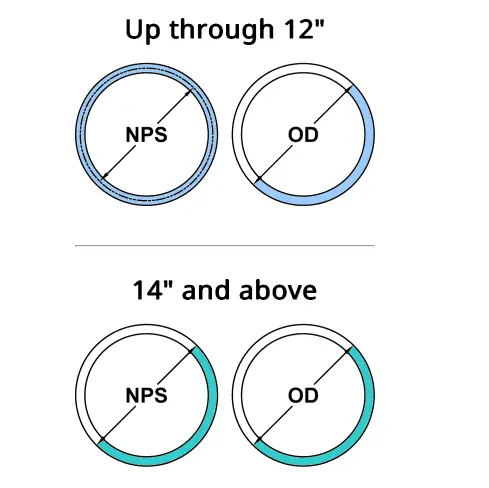
This distinction matters because choosing a pipe based only on the number stamped in a specification can lead to incorrect assumptions about its flow area, wall thickness, or actual dimensions.
From Iron Pipe Size (IPS) to Modern NPS
The history of NPS helps explain why modern pipe dimensions can seem unusual.
Before today’s standardized system, the Iron Pipe Size (IPS) system was used to designate pipe sizes. Under IPS, the size was intended to approximate the pipe’s inside diameter.
A so-called 6-inch IPS pipe, for example, originally had an inside diameter that was approximately six inches.
As the piping industry developed, manufacturers began standardizing the outside diameter of pipes while allowing wall thicknesses to vary. This created a more practical system in which pipes of the same nominal size could have different wall thicknesses while retaining the same outside diameter.
The development of standardized dimensions made it easier for pipe, fittings, and other components manufactured by different companies to work together.
The development of standardized pipe sizing traces to Robert Briggs of Pascal Iron Works, who developed pipe specifications in the 19th century in an effort to make pipe and fittings interchangeable between different mills. These specifications eventually influenced the modern pipe-size system.
That historical development is important because it explains why the term “nominal” is used: the designation represents a standardized size category rather than a precise physical measurement.
Why Doesn’t a 1-Inch Pipe Have a 1-Inch Inside Diameter?
This is perhaps the most common question people encounter when learning about NPS.
Consider an NPS 1 pipe.
Its actual outside diameter is approximately 33.4 mm, not 25.4 mm. The inside diameter then depends on the pipe’s wall thickness.
For example, these dimensions for NPS 1:
| Pipe designation | Outside diameter | Wall thickness | Inside diameter |
|---|---|---|---|
| NPS 1 Schedule 40 | 33.4 mm | 3.38 mm | 26.64 mm |
| NPS 1 Schedule 80 | 33.4 mm | 4.55 mm | 24.30 mm |
| NPS 1 Schedule 160 | 33.4 mm | 6.35 mm | 20.70 mm |
Notice what happens here: the outside diameter remains 33.4 mm while the inside diameter decreases as the wall becomes thicker.
This is the fundamental relationship between NPS, outside diameter, wall thickness, and inside diameter.
The basic relationship can be expressed as:
Inside Diameter = Outside Diameter − 2 × Wall Thickness
Therefore, an engineer cannot determine a pipe’s internal flow diameter from the NPS designation alone.
Understanding Pipe Schedule: SCH 40, SCH 80, SCH 160 and More
If NPS identifies the nominal pipe size, pipe schedule identifies a standardized wall-thickness category.
Pipe schedules were developed as industrial applications began demanding pipes capable of handling higher pressures and more demanding operating conditions.
Common designations include:
- Schedule 5
- Schedule 5S
- Schedule 10
- Schedule 10S
- Schedule 20
- Schedule 30
- Schedule 40
- Schedule 40S
- Schedule 60
- Schedule 80
- Schedule 80S
- Schedule 100
- Schedule 120
- Schedule 140
- Schedule 160
- STD
- XS
- XXS
The basic principle is straightforward:
For a given NPS, a larger schedule number generally means a thicker pipe wall.
Because the outside diameter remains standardized for a particular NPS, increasing wall thickness reduces the internal diameter.
This means NPS 4 Schedule 40 and NPS 4 Schedule 80 have the same nominal size and outside diameter, but Schedule 80 has a thicker wall and consequently a smaller inside diameter.
That difference can be extremely important when calculating flow capacity, pressure drop, velocity, weight, and piping-system performance.
NPS vs. Outside Diameter: What Engineers Need to Know
One of the most useful rules in piping is this:
For a given NPS, the outside diameter generally stays constant while the wall thickness changes with schedule.
For example, the following actual outside diameters:
- NPS 1: 33.4 mm
- NPS 2: 60.3 mm
- NPS 3: 88.9 mm
- NPS 4: 114.3 mm
- NPS 12: 323.9 mm
- NPS 14: 355.6 mm
This standardized outside diameter is extremely useful in piping design because fittings, flanges, welding dimensions, supports, and other components must be compatible with the pipe dimensions.
It also explains why simply converting an NPS number directly into millimeters can produce the wrong result.
What Is DN and How Does It Compare With NPS?
In many parts of the world, piping systems are specified using DN, or Diameter Nominal, rather than NPS.
DN is the metric-based nominal pipe-size designation used within international standards.
Like NPS, DN is a nominal designation rather than a statement of the exact measured inside or outside diameter.
Some common NPS-to-DN equivalents include:
| NPS | DN |
| 1/2 | 15 |
| 3/4 | 20 |
| 1 | 25 |
| 1 1/4 | 32 |
| 1 1/2 | 40 |
| 2 | 50 |
| 2 1/2 | 65 |
| 3 | 80 |
| 3 1/2 | 90 |
| 4 | 100 |
For NPS sizes of 4 and above, a commonly used relationship is:
DN = 25 × NPS
Thus, NPS 8 corresponds to approximately DN 200, while NPS 10 corresponds to DN 250.
However, these should be treated as standardized nominal equivalents—not as direct dimensional conversions.
NPS and DN Are Not Simply Inches-to-Millimeters Conversions
A common mistake is to assume:
1 inch = 25.4 mm
and then multiply every NPS designation by 25.4 to obtain the corresponding DN or pipe diameter.
That approach does not work for industrial pipe sizing.
For example:
NPS 4 ≠ exactly 101.6 mm outside diameter.
The actual outside diameter for NPS 4 is 114.3 mm. Its DN designation is DN 100.
The reason is that NPS and DN are standardized nominal systems, not simple mathematical conversions.
This distinction is particularly important when working with international engineering projects where North American and metric standards may appear in the same project documentation.
ASME B36.10 vs. ASME B36.19: What’s the Difference?
Pipe dimensional standards also depend on the pipe material.
For many carbon steel and alloy steel applications, dimensions are associated with ASME B36.10, which covers welded and seamless wrought steel pipe.
For stainless steel pipe, ASME B36.19 covers relevant outside diameters and schedule wall thicknesses. Note that stainless-steel dimensions under ASME B36.19 use the “S” suffix, such as:
- 10S
- 40S
- 80S
This distinction is important because a Schedule 40 designation and a Schedule 40S designation should not automatically be assumed to have identical wall thicknesses for every size.
Be cautious that differences can occur in certain larger sizes, particularly within the NPS 12 through NPS 22 range.
For that reason, engineers should always check the applicable dimensional standard rather than relying solely on the schedule number.
Schedule 40 vs. Schedule 40S
The terms Schedule 40 and Schedule 40S look almost identical, but the suffix has an important meaning.
The “S” designation is associated with stainless-steel pipe dimensions under ASME B36.19.
In many sizes, Schedule 40 and Schedule 40S may have the same dimensions. However, they are not universally interchangeable.
The same principle applies to:
- Schedule 10 vs. 10S
- Schedule 80 vs. 80S
Note that these schedules are often identical, but differences can appear at particular sizes.
Best practice: Always verify the applicable standard and actual wall thickness before selecting or replacing pipe.
Standard, Extra Strong and Double Extra Strong Pipe
Before the modern schedule system became established, several traditional wall-thickness categories were widely used.
These include:
Standard Weight (STD)
Standard wall construction was one of the original categories used to classify pipe thickness.
Extra Strong (XS)
Extra Strong pipe has a heavier wall than Standard pipe and was developed for applications requiring increased wall thickness.
Double Extra Strong (XXS)
Double Extra Strong provides an even heavier wall.
These designations remain relevant because they continue to appear in engineering specifications, piping material classes, procurement documents, and technical references.
Note that Extra Strong and Schedule 80 are identical up to and including NPS 8, while larger sizes can differ. Likewise, Standard and Schedule 40 are identical up to and including NPS 10 under the relationships described in its reference.
Therefore, engineers should avoid assuming that traditional designations and schedule numbers are universally interchangeable across every pipe size.
Why Pipe Schedule Matters in Real-World Piping Design
Pipe schedule is much more than a number printed on a material specification.
It influences several important engineering characteristics.
1. Pressure Capability
A thicker pipe wall can provide greater resistance to internal pressure, subject to material properties, temperature, design code, corrosion allowance, weld efficiency, and other engineering factors.
2. Flow Area
As wall thickness increases, the inside diameter decreases.
A smaller internal diameter can affect:
- Flow velocity
- Pressure drop
- Pump requirements
- Compressor requirements
- System capacity
3. Pipe Weight
A thicker wall generally means more material and therefore greater pipe weight.
This can affect:
- Pipe supports
- Structural steel
- Transportation
- Handling
- Installation
- Fabrication costs
4. Corrosion Allowance
Industrial piping may be designed with additional wall thickness to accommodate expected material loss during service.
5. Fabrication and Connection
The pipe’s actual dimensions influence welding, fitting selection, flange compatibility, machining, and fabrication procedures.
Consequently, selecting the correct pipe requires much more than choosing an NPS number.
Five Common Mistakes When Reading Pipe Sizes
Understanding NPS becomes much easier when you know the mistakes to avoid.
Mistake 1: Assuming NPS Equals Actual Inside Diameter
NPS is nominal. The inside diameter depends on wall thickness.
Mistake 2: Treating NPS as an Exact Inch Measurement
An NPS 4 pipe does not have an actual 4-inch outside diameter. Its standardized outside diameter is 114.3 mm.
Mistake 3: Ignoring Schedule
NPS alone does not tell you the pipe wall thickness.
Mistake 4: Assuming Schedule 40 and 40S Are Always Identical
They can be identical in many applications, but differences exist for certain sizes and standards.
Mistake 5: Treating DN as a Direct Metric Conversion
DN is a nominal designation, not simply the NPS number multiplied by 25.4.
A Simple Way to Read a Pipe Specification
Imagine a specification says:
NPS 6, Schedule 40
How should you interpret it?
NPS 6 tells you the nominal pipe size.
Schedule 40 identifies the applicable wall-thickness category.
The actual outside diameter is approximately 168.3 mm, while the actual inside diameter must be determined from the applicable wall thickness.
If the same NPS were specified with a heavier schedule, the outside diameter would generally remain standardized while the wall would become thicker and the inside diameter smaller.
This is why a complete pipe specification normally requires more information than simply “6-inch pipe.”
Why Standardized Pipe Dimensions Matter
Imagine a large refinery where thousands of pipe sections, elbows, tees, reducers, flanges, valves, and other components must fit together.
Without standardized dimensions, every manufacturer could produce components with slightly different dimensions.
That would create enormous problems during:
- Design
- Procurement
- Fabrication
- Installation
- Maintenance
- Equipment replacement
Standardized NPS dimensions solve this problem by creating a common dimensional framework.
The historical development of standardized pipe dimensions was driven partly by the need for interchangeability between manufacturers, a principle that remains fundamental to modern piping engineering.
NPS, Pipe Schedule and Flow Calculations
For process engineers, one of the most important consequences of pipe sizing is its effect on flow.
Because the internal diameter determines the available flow area, changing the schedule can influence system hydraulics.
For a circular pipe, the approximate cross-sectional flow area is:
A = πD² / 4
where D is the internal diameter.
If the internal diameter decreases, the available flow area decreases as well.
That can increase fluid velocity for the same volumetric flow rate and potentially increase pressure losses.
Therefore, hydraulic calculations should use the actual internal diameter, not simply the nominal pipe size.
This is one reason why pipe schedules matter in pumps, compressors, heat exchangers, process lines, utility systems, and long-distance pipelines.
The Bigger Picture: NPS Is a Language of Piping Engineering
NPS may initially seem confusing because its numbers do not always correspond directly to measured dimensions.
But once the system is understood, the logic becomes straightforward:
NPS tells you the nominal size.
Schedule tells you the wall-thickness category.
Outside diameter comes from the applicable dimensional standard.
Inside diameter depends on outside diameter and wall thickness.
DN provides a metric nominal designation.
This framework allows engineers, manufacturers, contractors, and maintenance teams to communicate about piping dimensions consistently.
Final Takeaway: Master NPS Before Selecting Pipe
Understanding Nominal Pipe Size (NPS) is fundamental for anyone working with industrial piping.
The most important lesson is simple: a pipe’s nominal size is not necessarily its actual inside or outside diameter.
For a particular NPS, the standardized outside diameter generally remains fixed while different schedules provide different wall thicknesses. Increasing the wall thickness reduces the inside diameter, which can affect flow capacity, velocity, pressure drop, weight, and other design considerations.
Likewise, DN is not simply an inch-to-millimeter conversion. It is another standardized nominal designation used widely in international piping practice.
For engineers and piping professionals, the safest approach is to always verify the applicable dimensional standard, pipe material, NPS, schedule, wall thickness, and actual dimensions before ordering, fabricating, installing, or replacing pipe.
Ultimately, mastering NPS and pipe schedules isn’t just about memorizing a table of numbers. It is about understanding the standardized language that allows complex piping systems to be designed and built reliably.