Modern buildings are becoming increasingly complex, energy-intensive, and performance-driven. As sustainability expectations rise and operational costs continue to attract scrutiny, facility owners and engineers are seeking smarter ways to manage Heating, Ventilation, and Air Conditioning (HVAC) systems. In this evolving landscape, Fault Detection & Diagnostics (FDD) has emerged as a transformative capability that enables buildings to operate more efficiently, reliably, and intelligently.
FDD represents a significant shift from traditional reactive maintenance approaches to a data-driven, predictive, and optimization-focused strategy. By continuously monitoring system behavior, identifying anomalies, and diagnosing faults in real time, FDD helps ensure that HVAC systems perform at their intended design efficiency throughout their lifecycle.
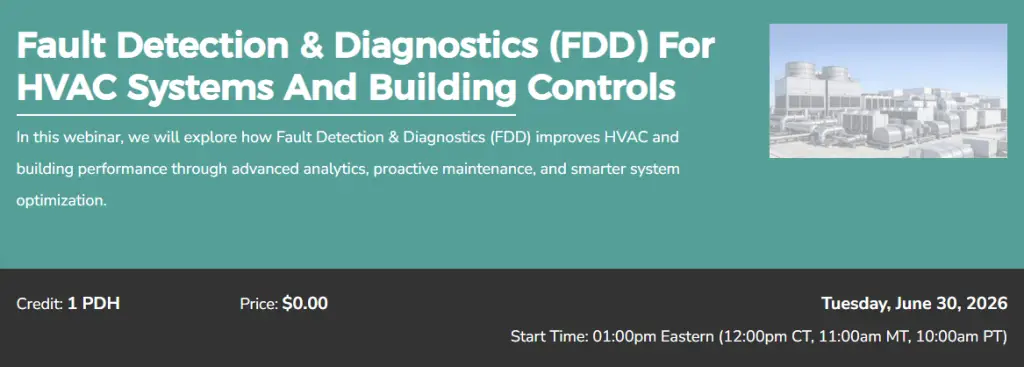
To explore these advanced capabilities in detail, a free professional webinar on Fault Detection & Diagnostics for HVAC Systems and Building Controls has been organized for engineers, facility managers, consultants, and building automation professionals. This session will provide practical insights into how FDD is reshaping building operations and enabling measurable performance improvements.
Webinar Overview: Advancing HVAC Intelligence Through FDD
The upcoming webinar, titled “Fault Detection & Diagnostics (FDD) for HVAC Systems and Building Controls,” is designed to provide a comprehensive understanding of how modern analytics and control strategies are transforming building performance.
Rather than relying solely on scheduled maintenance or manual inspections, FDD enables continuous system monitoring and automated fault identification. This ensures that inefficiencies, equipment degradation, and operational issues are detected early—often before they impact occupant comfort or energy consumption.
The session will also highlight how advanced analytics, artificial intelligence (AI), and standardized control frameworks such as ASHRAE Guideline 36 are being integrated into building automation systems to create highly efficient, self-optimizing environments.
Participants will gain both conceptual knowledge and practical guidance on implementing FDD solutions in real-world facilities.
The Evolution of Building Operations: From Reactive to Predictive Maintenance
Traditional Maintenance Practices
Historically, building HVAC systems have been maintained using reactive or time-based strategies. In such approaches:
- Equipment is serviced after a failure occurs
- Maintenance is performed at fixed intervals regardless of actual system condition
- Faults are often detected only after they cause noticeable performance degradation
While simple to implement, these methods often lead to unnecessary downtime, higher operational costs, and inefficient energy usage.
The Shift Toward Predictive and Intelligent Systems
With advancements in digital technologies, the building industry is transitioning toward predictive maintenance models. These systems use real-time data, analytics, and machine learning algorithms to:
- Detect anomalies before failures occur
- Identify inefficiencies in system operation
- Optimize equipment performance continuously
- Reduce unplanned downtime and maintenance costs
Fault Detection & Diagnostics plays a central role in this transformation by enabling continuous system intelligence.
Understanding Fault Detection & Diagnostics (FDD)
Fault Detection & Diagnostics refers to a set of technologies and methodologies used to automatically identify, analyze, and diagnose faults within HVAC systems and building controls.
FDD systems typically operate by:
- Collecting real-time data from sensors and building automation systems
- Comparing actual performance against expected behavior models
- Detecting deviations or abnormal patterns
- Diagnosing probable causes of system inefficiencies or failures
By providing actionable insights, FDD allows facility teams to address issues proactively rather than reactively.
Key Themes of the Webinar
The webinar will provide an in-depth exploration of several critical aspects of FDD implementation and its role in modern building operations.
1. Enhancing HVAC Reliability and Performance Through FDD
One of the primary objectives of FDD is to improve the overall reliability and performance of HVAC systems. The webinar will explain how continuous monitoring helps:
- Identify system inefficiencies early
- Prevent unexpected equipment failures
- Maintain consistent indoor environmental conditions
- Improve overall system uptime and dependability
By ensuring that systems operate as intended, FDD contributes directly to improved occupant comfort and operational stability.
2. Energy Efficiency and Operational Optimization
Energy consumption in commercial and institutional buildings is heavily influenced by HVAC performance. Even minor inefficiencies can lead to significant energy waste over time.
FDD helps address this challenge by:
- Identifying energy-wasting faults such as sensor drift or valve leakage
- Optimizing system setpoints and control sequences
- Reducing unnecessary equipment runtime
- Ensuring systems operate within optimal efficiency ranges
As a result, organizations can achieve meaningful reductions in energy consumption and operational expenditure.
3. Integration with Building Automation Systems and Advanced Analytics
Modern FDD solutions are deeply integrated with Building Automation Systems (BAS), allowing seamless access to real-time operational data.
The webinar will explore how:
- BAS platforms serve as the foundation for FDD implementation
- Analytics engines process large volumes of building data
- Visualization tools help operators interpret system performance
- Automated alerts support rapid decision-making
This integration enables a unified approach to building management, where data-driven insights guide operational decisions.
4. Role of ASHRAE Guideline 36 in High-Performance Controls
A key component of modern HVAC optimization is ASHRAE Guideline 36, which defines standardized control sequences for high-performance HVAC systems.
The webinar will explain how this guideline contributes to:
- Improved coordination between HVAC components
- Faster system response to changing load conditions
- Reduced energy consumption through optimized control logic
- Consistent performance across different building systems
When combined with FDD technologies, ASHRAE Guideline 36 helps create highly efficient and predictable building environments.
5. AI-Enhanced Diagnostics and Rule-Based Fault Detection
FDD systems utilize a combination of traditional rule-based logic and advanced AI-driven analytics to identify system faults.
The webinar will discuss:
- Rule-based detection methods for known fault conditions
- Machine learning models that identify complex or emerging patterns
- Hybrid approaches that combine both techniques for improved accuracy
This dual approach enables more comprehensive fault identification across a wide range of HVAC system configurations.
6. Common HVAC Faults and Diagnostic Strategies
Participants will gain insight into the most frequently encountered HVAC system faults, including:
- Air-side issues such as damper malfunction, airflow imbalance, and filter clogging
- Water-side issues such as pump inefficiency, valve leakage, and heat exchanger fouling
- Sensor inaccuracies and calibration errors
- Control loop instability and configuration issues
Understanding these faults and their diagnostic indicators is essential for effective system management and maintenance planning.
7. Implementing FDD in Modern Building Environments
Beyond detection, successful FDD implementation requires careful planning and integration.
The webinar will guide participants on how to:
- Specify FDD requirements during system design and procurement
- Deploy FDD tools within existing or new building automation systems
- Establish monitoring and maintenance workflows
- Ensure long-term system performance and data integrity
These practical insights will help organizations adopt FDD in a structured and effective manner.
Learning Outcomes
In just one hour, participants will gain valuable knowledge and practical understanding of Fault Detection & Diagnostics in HVAC systems.
Key Learning Objectives:
- Understanding the role of FDD in improving HVAC reliability, energy efficiency, and operational performance
- Learning how building automation systems, analytics platforms, and ASHRAE Guideline 36 work together for proactive diagnostics
- Identifying and diagnosing common air-side and water-side HVAC faults using both rule-based and AI-enhanced methods
- Gaining practical guidance on specifying, deploying, and managing FDD solutions within modern building automation environments
These outcomes are designed to support professionals in enhancing building performance and achieving measurable operational improvements.
Why Fault Detection & Diagnostics Matters Today
As buildings become more complex and energy costs continue to rise, the importance of intelligent system management has never been greater. Fault Detection & Diagnostics provides a pathway to:
- Reduce operational inefficiencies
- Extend equipment lifespan
- Improve occupant comfort and satisfaction
- Achieve sustainability and carbon reduction goals
- Lower maintenance and lifecycle costs
By enabling continuous visibility into system performance, FDD empowers facility teams to make informed, proactive decisions.
Webinar Details and Schedule
This one-hour professional session has been designed for global accessibility across multiple time zones.
Webinar Title:
Fault Detection & Diagnostics (FDD) for HVAC Systems and Building Controls
Date:
Tuesday, June 30, 2026
Time:
01:00 PM Eastern Time (ET)
12:00 PM Central Time (CT)
11:00 AM Mountain Time (MT)
10:00 AM Pacific Time (PT)
The session will be led by experienced industry professionals specializing in HVAC systems, building automation, and advanced analytics.
Register for the Webinar
Professionals interested in advancing their knowledge of intelligent building operations and HVAC optimization are warmly invited to attend this complimentary session.
To register for the webinar, please use the link below:
👉 https://noonpi.com/register-free-webinar/?webinar=NP-F-1061W&additional_fields=1
Conclusion
Fault Detection & Diagnostics represents a significant advancement in the way modern buildings are operated and maintained. By shifting from reactive maintenance to intelligent, data-driven decision-making, FDD enables organizations to achieve higher efficiency, improved reliability, and reduced operational costs.
This webinar offers a valuable opportunity to gain practical insights into the technologies, methodologies, and implementation strategies that are shaping the future of building automation and HVAC performance.
For professionals committed to enhancing building efficiency and sustainability, this session provides an essential foundation for understanding and applying next-generation diagnostic solutions in real-world environments.