In every industrial facility—whether it is a refinery, power plant, LNG terminal, or chemical processing unit—piping systems are constantly exposed to thermal expansion, vibration, equipment movement, and mechanical stress. Without proper flexibility, these forces can quickly lead to catastrophic failures such as cracked welds, nozzle overloads, flange leakage, or even complete system breakdown.
To manage these challenges, engineers rely on a highly specialized component: Expansion Joints (Bellows).
Although they may appear simple externally, expansion joints are among the most complex and sensitive components in piping design. Their performance directly influences system safety, reliability, and lifecycle cost. A poorly selected or misapplied bellows can do more harm than good.
This article explores the working principles, types, applications, and critical design considerations of expansion joints in piping systems, with a strong focus on real-world engineering behavior.
What is an Expansion Joint (Bellow)?
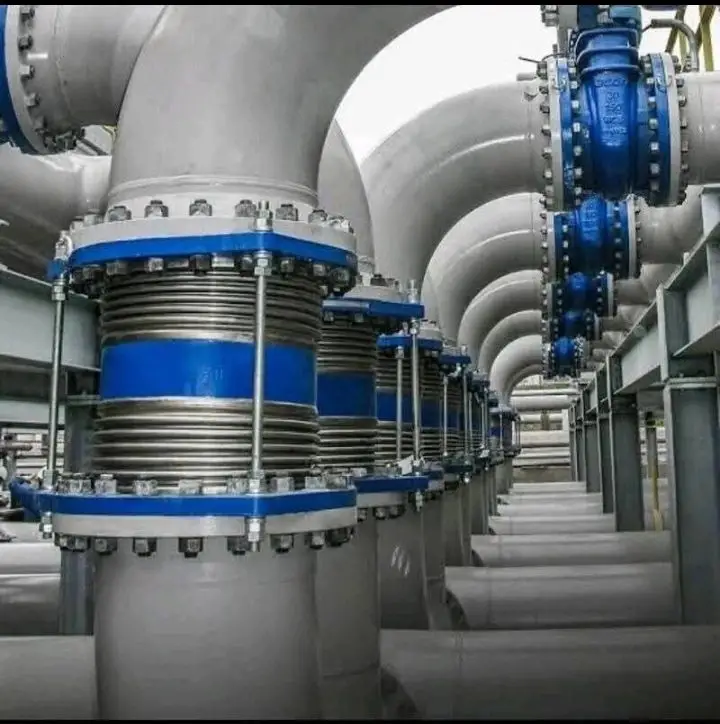
An expansion joint, commonly called a metallic bellow, is a flexible piping component designed to absorb movement in a pipeline system.
It accommodates:
- Thermal expansion and contraction
- Mechanical vibration
- Equipment movement or settlement
- Misalignment between connected piping sections
In simple terms:
An expansion joint acts as a controlled “flexible zone” in an otherwise rigid piping system.
It allows the pipeline to move safely without transmitting excessive stress to connected equipment or supports.
Why Expansion Joints Are Needed in Piping Systems
Pipelines are rarely static. As operating conditions change, pipes expand, shift, and vibrate. Without flexibility, these movements create high stresses.
Key reasons expansion joints are used:
1. Thermal Expansion Control
When a pipe heats up, it expands. In long pipelines, this expansion can be significant and must be absorbed safely.
2. Reducing Nozzle Loads
Pumps, compressors, and turbines have strict limits on allowable loads. Expansion joints help isolate these forces.
3. Vibration Isolation
Rotating equipment generates vibrations that can propagate through piping systems. Bellows help dampen this effect.
4. Compensating Misalignment
During installation or due to structural settlement, perfect alignment is rarely achieved.
5. Space Constraints
In compact layouts where loops or offsets are not feasible, expansion joints provide a compact flexibility solution.
Basic Construction of a Metallic Expansion Joint
A metallic bellows is not just a flexible tube—it is a precision-engineered component.
Key components include:
1. Bellows Element
The flexible core made of thin-walled metal, typically stainless steel or alloy materials. It provides axial, lateral, and angular movement.
2. End Fittings
These are welded or attached to connect the bellows to the piping system.
3. Reinforcement Rings (if applicable)
Used to prevent excessive deformation under pressure.
4. Internal Liner
Installed to reduce flow-induced turbulence and protect the bellows from erosion.
5. External Cover / Shroud
Provides protection against external damage or environmental exposure.
Each of these components plays a critical role in ensuring safe and controlled movement.
Types of Expansion Joints in Piping Systems
Expansion joints are not one-size-fits-all. Different types are used depending on movement requirements.
1. Axial Expansion Joints
Designed to absorb movement along the pipe axis.
- Compression and extension movement
- Common in straight pipelines
- Requires strong anchoring systems
2. Lateral Expansion Joints
Used when pipes move sideways relative to each other.
- Often used in offset piping layouts
- Requires tie rods or hinge mechanisms
3. Angular Expansion Joints
Designed to absorb rotation or angular movement.
- Typically used in pairs or sets
- Common in complex piping geometries
4. Universal Expansion Joints
A combination of two bellows connected by a central pipe section.
- Allows large lateral movement
- Used in misaligned piping systems
5. Gimbal Expansion Joints
Designed for multi-directional angular movement.
- Used where rotation occurs in multiple planes
- Includes gimbal rings for stability
6. Pressure Balanced Expansion Joints
Used to eliminate pressure thrust forces.
- Ideal for high-pressure systems
- Prevents anchor overloads
How Expansion Joints Work
The working principle of a bellows is based on controlled elastic deformation.
When pipeline movement occurs:
- The bellows compresses, expands, bends, or rotates
- Internal stress is distributed across multiple convolutions
- Movement is absorbed without transferring full load to anchors
However, this flexibility comes at a cost: bellows are also sensitive to overloading, misalignment, and improper installation.
Key Movements Absorbed by Expansion Joints
Expansion joints are designed to handle three primary types of movement:
1. Axial Movement
Movement along the pipe axis due to thermal expansion or contraction.
2. Lateral Movement
Sideways displacement caused by structural movement or misalignment.
3. Angular Movement
Rotation or bending between connected pipe sections.
In real systems, these movements often occur simultaneously, making the design significantly more complex. Refer to the article below to know about design considerations for Expansion Joints:
Where Expansion Joints Are Used in Industry
Expansion joints are widely used across industrial sectors:
1. Power Plants
- Steam piping systems
- Boiler outlet lines
- Turbine exhaust connections
2. Oil & Gas Refineries
- Process piping networks
- Crude and product pipelines
- Heater and furnace connections
3. Petrochemical Plants
- Reactor systems
- High-temperature process lines
4. LNG and Cryogenic Facilities
- Extremely low-temperature pipelines
- Cryogenic transfer systems
5. HVAC and Ducting Systems
- Air handling systems
- Exhaust and flue gas ducts
Each application has unique design challenges related to temperature, pressure, and movement cycles.
Critical Design Considerations for Expansion Joints
Expansion joints are not “off-the-shelf flexible components.” They require careful engineering.
1. Movement Capacity
The bellows must accommodate expected axial, lateral, and angular movement without overstressing.
2. Pressure Rating
Internal pressure generates axial thrust forces that must be resisted by anchors or pressure-balanced designs.
3. Fatigue Life
Bellows fail primarily due to cyclic fatigue, not static stress. Designers must evaluate:
- Number of operating cycles
- Stress range per cycle
- Design fatigue life (e.g., 1000, 5000, 10,000 cycles)
4. Temperature Effects
High temperatures reduce material strength and fatigue life.
5. Anchor and Support Design
Expansion joints cannot function properly without properly designed anchors and guides.
Common Failure Modes of Expansion Joints
Understanding failure modes is essential for safe design.
1. Fatigue Failure
Repeated cycling leads to cracking in bellows convolutions.
2. Over-Extension or Over-Compression
Exceeding movement limits causes permanent deformation.
3. Instability or Squirm
High internal pressure can cause bellows instability.
4. Corrosion and Erosion
Aggressive fluids or high-velocity flow can degrade the bellows.
5. Improper Installation
Misalignment or missing guides leads to early failure.
Importance of Guides and Anchors
Expansion joints cannot function independently. They are part of a controlled system.
Anchors
- Absorb pressure thrust forces
- Fix pipeline movement points
- Prevent excessive system displacement
Guides
- Ensure axial movement only
- Prevent lateral buckling
- Maintain alignment of piping system
Without proper anchors and guides, expansion joints are highly vulnerable to failure.
Expansion Joints vs Expansion Loops
A common design alternative to bellows is the expansion loop.
Expansion Loops:
- Made from pipe bends
- Use pipe flexibility to absorb movement
- Highly reliable and maintenance-free
- Require more space
Expansion Joints:
- Compact solution
- Require less space
- More complex and sensitive
- Require maintenance and inspection
Engineers often choose expansion joints when space constraints make loops impractical.
Advantages of Expansion Joints
- Compact flexibility solution
- Reduced stress on equipment
- Effective vibration isolation
- Suitable for complex layouts
- Can handle multi-directional movement
Limitations of Expansion Joints
Despite their usefulness, expansion joints have limitations:
- Limited fatigue life
- Require precise installation
- Sensitive to misalignment
- Higher maintenance requirements
- Depend heavily on the correct support design
Best Practices for Reliable Expansion Joint Design
To ensure long-term performance:
- Perform accurate stress analysis before selection
- Never exceed movement limits
- Design proper anchors and guides
- Consider fatigue life under operating cycles
- Avoid unnecessary use where loops are feasible
- Ensure correct installation alignment
- Inspect periodically during shutdowns
Conclusion
Expansion joints (bellows) are essential components in modern piping systems, enabling engineers to manage thermal expansion, vibration, and mechanical movement in compact and efficient ways. However, they are also highly specialized devices that require careful design, correct installation, and strict adherence to operating limits.
Unlike rigid pipe components, bellows behave dynamically under pressure, temperature, and cyclic loading. Their performance depends not just on design specifications, but on how accurately real-world conditions match engineering assumptions.
When properly designed and applied, expansion joints protect critical equipment, extend system life, and ensure operational safety. When misused, they can become one of the weakest points in a piping system.
Ultimately, they represent a powerful reminder in piping engineering:
Flexibility must always be designed—not assumed.