In modern piping engineering, managing thermal movement is one of the most critical design challenges. As pipelines heat up and cool down, they expand and contract, generating significant forces at supports. If these forces are not properly controlled, they can lead to equipment nozzle overloads, pipe distortion, and even structural failure.
This is where PTFE (Polytetrafluoroethylene) slide plates have become a widely adopted solution. Known for their exceptionally low friction properties, PTFE-based sliding systems are used extensively in piping supports, pipe racks, and equipment interfaces to allow controlled movement with minimal resistance.
However, while PTFE is often treated as a “plug-and-play low-friction material,” the reality is far more nuanced. Its performance is not constant—it depends strongly on contact pressure, installation conditions, and long-term mechanical behavior.
This article explores the engineering applications of PTFE in piping supports and explains why understanding its pressure-dependent behavior is essential for reliable stress design.
What is PTFE, and Why is it Used in Piping Supports?
PTFE (Polytetrafluoroethylene) is a high-performance fluoropolymer known for:
- Extremely low coefficient of friction
- Excellent chemical resistance
- High temperature tolerance (moderate range)
- Non-stick surface characteristics
- Long-term durability under controlled conditions
In piping systems, PTFE is commonly used in the form of:
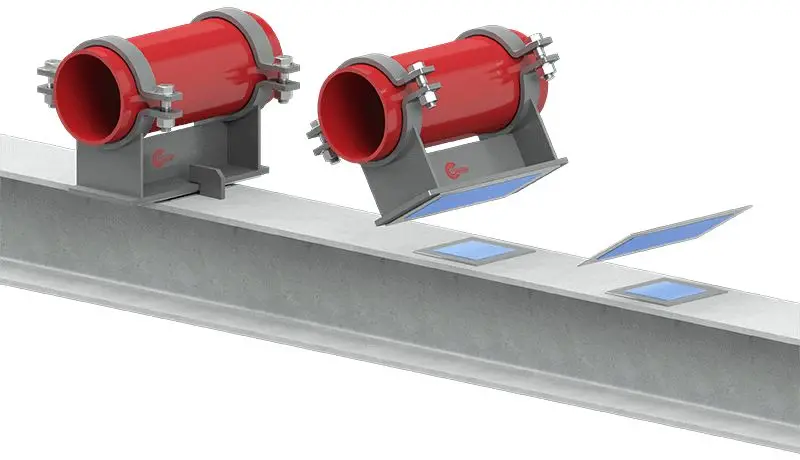
- Slide plates (PTFE on carbon steel or stainless steel)
- Skid bearings
- Expansion support pads
- Sliding shoes in pipe racks
- Equipment support interfaces
Its primary purpose is simple:
Allow controlled sliding movement of piping systems while minimizing frictional resistance.
This helps reduce thermal stress and prevents overloading fixed anchors or sensitive equipment nozzles.
Why PTFE Slide Plates Are So Widely Used
PTFE has become almost a default choice in many stress designs because it offers:
1. Low Friction for Thermal Movement
Thermally expanding pipelines require supports that “give way” smoothly. PTFE reduces resistance, allowing movement with minimal force buildup.
2. Reduced Axial and Lateral Loads
Lower friction means lower longitudinal and lateral loads transferred to anchors, reducing structural steel requirements.
3. Protection of Equipment Nozzles
Excess friction can push loads into pumps, compressors, and heat exchangers. PTFE helps isolate these forces.
4. Maintenance-Free Operation
Unlike roller supports, PTFE slide plates have no moving mechanical parts.
Because of these advantages, engineers often assume PTFE guarantees low friction under all conditions. This is where critical misunderstandings begin.
The Hidden Reality: PTFE Friction is NOT Constant
One of the most overlooked aspects in piping stress design is this:
PTFE does NOT have a fixed coefficient of friction.
Instead, its behavior depends heavily on contact pressure between mating surfaces.
This means that the same PTFE slide plate can behave very differently depending on how much load is applied.
Let’s break it down.
1. Low Contact Pressure: When PTFE Underperforms
At first glance, low load might seem beneficial. But in PTFE sliding systems, low contact pressure can actually degrade performance.
What happens at low pressure:
- Surface asperities (microscopic roughness) do not flatten properly
- PTFE does not form a stable transfer film on the mating surface
- Localized sticking points develop
- Stick-slip behavior becomes more likely
Engineering consequence:
Instead of smooth sliding, the system may experience:
- Jerky movement
- Higher-than-expected friction
- Unpredictable displacement behavior
This is particularly dangerous in:
- Cold systems with low operating loads
- Light piping spans
- Improperly distributed support reactions
Ironically, even though PTFE is known for low friction, too little pressure can prevent it from working effectively.
2. Optimal Contact Pressure: The Design Sweet Spot
PTFE performs best when it operates within a well-defined pressure range.
What happens at optimal pressure:
- PTFE undergoes controlled cold flow
- Surface asperities flatten uniformly
- A stable transfer film develops on the counter surface
- Sliding becomes smooth and repeatable
Engineering outcome:
- Predictable coefficient of friction
- Stable displacement in stress analysis
- Reduced risk of stick-slip
- Reliable long-term operation
This is the condition engineers assume in most software models like CAESAR II, where a constant low friction coefficient (μ) is used.
However, this assumption is only valid if the real system operates in this optimal pressure window.
3. Excessive Contact Pressure: When PTFE Fails Gradually
At the other extreme, too much load introduces another set of problems.
What happens at excessive pressure:
- PTFE begins to creep excessively
- Permanent deformation occurs
- Material thinning increases over time
- Wear rate accelerates significantly
Engineering consequences:
- Increase in friction over time
- Loss of sliding efficiency
- Potential binding of supports
- Reduced service life of the slide assembly
Unlike brittle failure, PTFE degradation under high pressure is often progressive, meaning problems may not be immediately visible but worsen over time.
Why PTFE Friction Behavior is Pressure-Dependent
The reason behind this non-linear behavior lies in the material’s nature:
PTFE is a soft, viscoelastic polymer. Its surface interacts with steel or stainless steel mating surfaces in a way that depends on:
- Real contact area
- Plastic deformation
- Transfer film formation
- Time-dependent creep behavior
As pressure changes:
- The real contact area changes
- Surface interaction mode changes
- Friction mechanism shifts
This is why PTFE cannot be treated like steel-on-steel friction with a constant μ value.
The Critical Design Parameter Engineers Often Miss
Manufacturers of PTFE slide plates do not simply provide a friction coefficient. They also define a key but often overlooked requirement:
Allowable bearing pressure range (Pmin to Pmax)
This range defines where PTFE performs as intended.
Why this matters:
- Below Pmin → unstable sliding, higher friction
- Within range → optimal low-friction performance
- Above Pmax → accelerated creep and wear
The Engineering Check That Should Never Be Skipped
After calculating support reactions in a stress analysis tool, engineers must verify:
Step 1: Determine actual bearing pressure
P=Contact AreaLoad
Step 2: Compare with vendor limits
Pmin≤P≤Pmax
Step 3: Validate assumption
Only if this condition is satisfied can the assumed friction coefficient be considered realistic.
Why This Matters in CAESAR II and Stress Analysis
Many piping systems are designed using software like CAESAR II, where:
- PTFE supports are modeled with a fixed friction coefficient (e.g., μ = 0.05 or 0.1)
- Thermal expansion loads are calculated based on this assumption
However, if actual field conditions fall outside the PTFE pressure range:
- The real friction may be significantly higher
- Predicted displacement may be inaccurate
- Anchor loads may be underestimated
- Equipment nozzles may experience unexpected loads
This mismatch between model assumptions and physical reality is a major source of piping system failures and commissioning surprises.
Key Applications of PTFE or Teflon in Piping Supports
PTFE slide systems are widely used in various engineering applications:
1. Pipe Racks in Oil & Gas Facilities
- Long-distance thermal movement
- Reduced friction at multiple support points
2. LNG and Cryogenic Systems
- Controlled expansion and contraction
- Minimizing stress on cold-box piping
3. Power Plant Steam Piping
- High thermal expansion systems
- Protection of turbine nozzles
4. Petrochemical Plants
- Large diameter, high-temperature pipelines
- Multi-directional movement supports
5. Equipment Piping Interfaces
- Pump suction and discharge lines
- Heat exchanger nozzle connections
In all these cases, PTFE helps reduce restraint forces—but only when properly designed.
Common Engineering Mistakes in PTFE Slide Design
1. Assuming a constant friction coefficient
One of the most widespread errors.
2. Ignoring bearing pressure verification
Designs often skip vendor pressure limits.
3. Oversized or undersized slide areas
Incorrect area selection leads to a pressure imbalance.
4. Not accounting for long-term creep
PTFE behavior changes over time under sustained load.
Best Practices for Reliable PTFE Slide Design
To ensure safe and predictable performance:
- Always verify bearing pressure against the vendor range
- Avoid extremely low contact loads
- Design for uniform load distribution
- Consider long-term creep behavior
- Use conservative friction values where uncertainty exists
- Perform sensitivity checks in stress analysis models
Conclusion
PTFE slide plates are one of the most powerful tools in piping stress engineering for reducing friction and managing thermal movement. However, their behavior is not as simple as assigning a constant low friction coefficient in design software.
Their performance is governed by a delicate balance of contact pressure, surface interaction, and material deformation.
When pressure is too low, sliding becomes unstable.
When pressure is optimal, PTFE performs exactly as intended.
When pressure is too high, long-term reliability deteriorates.
The key takeaway is simple but critical:
A PTFE slide plate only delivers low friction when it operates within its design pressure window—not just when it is specified in a model.
Understanding this distinction is what separates routine piping design from truly reliable engineering.