Pipeline infrastructure plays a critical role in the global energy and industrial landscape, transporting oil, gas, chemicals, water, and other essential resources across vast distances. As these networks continue to expand in scale and complexity, pipeline operators are facing increasing challenges related to operational reliability, environmental safety, regulatory compliance, cybersecurity, and product security.
Traditional pipeline leak detection systems, while effective in earlier operating environments, are now being tested by rapidly changing conditions. Modern pipeline operations require systems capable of handling dynamic flow variations, detecting increasingly sophisticated threats, and minimising operational risks without generating excessive false alarms.
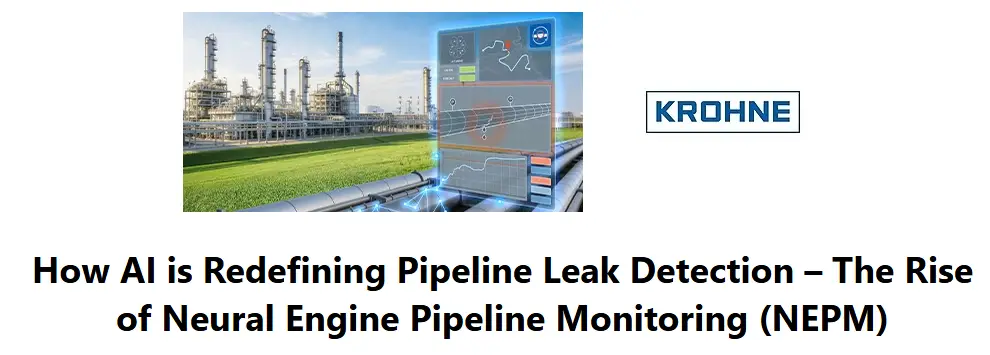
In response to these evolving demands, a new generation of intelligent monitoring systems is emerging. Among the most promising advancements is Neural Engine Pipeline Monitoring (NEPM)—an advanced approach that integrates artificial intelligence (AI), hydraulic modelling, and real-time sensor analytics to create adaptive, self-learning pipeline monitoring systems.
To explore this innovative technology and its practical applications, an online free webinar titled “How AI is Redefining Pipeline Leak Detection – The Rise of Neural Engine Pipeline Monitoring (NEPM)” has been organised. The session will provide valuable insights into how AI is reshaping modern pipeline operations and improving leak detection capabilities.
Webinar Overview: Understanding the Next Evolution in Pipeline Monitoring
The upcoming webinar will examine how Artificial Intelligence is transforming the way pipeline systems are monitored, analyzed, and protected. It will focus specifically on the growing adoption of Neural Engine Pipeline Monitoring (NEPM) and its role in enhancing operational intelligence.
The session is designed to help industry professionals understand:
- Why conventional leak detection approaches are facing limitations
- How AI-driven monitoring systems improve detection accuracy
- The role of real-time data and hydraulic modelling in modern pipeline management
- How intelligent systems reduce false alarms while improving sensitivity
Participants will gain practical knowledge from industry experts on how NEPM technologies are being applied in real-world pipeline operations.
The Growing Challenges in Pipeline Operations
Pipeline operators today are working within an environment that is significantly more demanding than ever before. Several factors are contributing to the increasing complexity of pipeline management.
1. Dynamic Operating Conditions
Modern pipeline systems operate under continuously changing conditions. Variations in flow rates, pressure fluctuations, product characteristics, and operational demands create challenges for traditional monitoring systems that rely on static assumptions.
Conventional leak detection methods often struggle to accurately distinguish between normal operational changes and actual leak events, resulting in delayed detection or excessive false alarms.
2. Increasing Regulatory Requirements
Environmental protection and operational safety regulations are becoming increasingly stringent across global markets. Regulatory agencies now expect pipeline operators to:
- Detect leaks more rapidly
- Improve reporting accuracy
- Minimize environmental impact
- Demonstrate proactive risk management
Meeting these expectations requires more advanced monitoring technologies capable of delivering higher sensitivity and operational reliability.
3. Rising Cybersecurity and Security Threats
Pipeline infrastructure is increasingly vulnerable to cybersecurity risks and physical threats such as illegal tapping, theft, and unauthorised access.
Traditional monitoring systems were not originally designed to identify these sophisticated threats in real time. Modern AI-based systems, however, can analyse operational patterns continuously and identify anomalies that may indicate security breaches or unauthorised activities.
4. Operational Efficiency and Cost Pressures
Pipeline operators must balance safety and compliance requirements with economic performance. Excessive false alarms, inefficient maintenance practices, and unnecessary shutdowns can significantly increase operational costs.
As a result, there is a growing demand for intelligent systems that improve accuracy while reducing unnecessary operational disruptions.
What Is Neural Engine Pipeline Monitoring (NEPM)?
Neural Engine Pipeline Monitoring (NEPM) represents a next-generation approach to pipeline leak detection and operational analytics.
Unlike conventional systems that rely solely on predefined rules or threshold limits, NEPM combines several advanced technologies into a unified monitoring framework:
- Artificial Intelligence (AI)
- Hydraulic modelling
- Real-time sensor integration
- Machine learning algorithms
- Adaptive operational analytics
This integrated approach enables the pipeline monitoring system to continuously learn from operational behavior, adapt to changing conditions, and improve detection performance over time.
How NEPM Enhances Leak Detection Performance
One of the most significant advantages of NEPM is its ability to improve leak detection sensitivity while simultaneously reducing false alarms.
1. Integration of Hydraulic Modelling
Hydraulic models simulate the physical behaviour of fluids within the pipeline under various operating conditions. These models help establish expected system performance patterns.
When actual operating data deviates from expected hydraulic behaviour, the system can identify potential leak conditions with greater accuracy.
This allows operators to:
- Detect smaller leaks earlier
- Improve response times
- Reduce uncertainty during operational changes
2. Real-Time Sensor Data Analysis
Modern pipelines are equipped with large numbers of sensors that continuously measure:
- Pressure
- Flow rates
- Temperature
- Density
- Acoustic signals
NEPM systems process this real-time data continuously, allowing rapid identification of abnormal system behavior.
By combining sensor data with AI-based analytics, the system can distinguish between legitimate operational variations and actual leak events more effectively than conventional approaches.
3. AI-Driven Optimization and Learning
Artificial Intelligence enables NEPM systems to evolve over time by learning from operational history and system behavior.
This allows the monitoring system to:
- Adapt to changing operating conditions
- Improve anomaly recognition accuracy
- Reduce nuisance alarms
- Enhance predictive capabilities
The result is a smarter, more responsive pipeline monitoring environment.
Reducing False Alarms: A Critical Industry Need
False alarms are one of the most persistent challenges in pipeline monitoring. Excessive false positives can:
- Reduce operator confidence in monitoring systems
- Increase operational inefficiencies
- Trigger unnecessary shutdowns or inspections
- Divert attention from genuine incidents
NEPM addresses this challenge through intelligent analytics and contextual system understanding. By evaluating multiple data sources simultaneously, the system can make more informed decisions before generating alerts.
This significantly improves operational reliability and operator trust.
Addressing Illegal Tapping and Product Theft
In many regions, illegal tapping and product theft represent serious operational and financial risks for pipeline operators.
Traditional systems often struggle to identify these events, especially when theft activities are designed to mimic normal operating conditions.
AI-enhanced monitoring systems offer several advantages:
- Detection of subtle pressure anomalies
- Recognition of unusual flow signatures
- Identification of suspicious operational patterns
- Faster response to unauthorised activity
As a result, NEPM technologies are becoming increasingly valuable not only for leak detection but also for overall pipeline security management.
Practical Insights from Industry Experts
A major highlight of the webinar is the opportunity to hear directly from specialists at KROHNE, a globally recognised provider of industrial process instrumentation and pipeline management solutions.
The session will focus on separating practical, measurable AI applications from general industry hype. Participants will gain insight into where AI is delivering real operational improvements and how pipeline operators can evaluate emerging technologies realistically.
Featured Speaker
The webinar will be presented by:
Maximilian Ihring
As a specialist in pipeline management technologies, Maximilian Ihring will share expert perspectives on how AI-driven monitoring systems are evolving and how operators can leverage these technologies to improve safety, efficiency, and operational resilience.
Key Learning Outcomes
Participants attending this webinar will gain a valuable understanding of several important topics, including:
Understanding NEPM Technology
Learn how Neural Engine Pipeline Monitoring integrates AI, hydraulic modelling, and real-time sensor data to improve leak detection performance.
Improving Detection Sensitivity
Explore how modern AI-driven systems increase leak detection accuracy while minimising false alarms and operational disruptions.
Managing Modern Pipeline Challenges
Understand how intelligent monitoring systems help operators respond to evolving operational demands, tighter regulations, and rising security threats.
Real-World AI Applications
Hear from KROHNE experts about where Artificial Intelligence is delivering measurable benefits in modern pipeline monitoring systems.
Why This Webinar Matters
Artificial Intelligence is rapidly becoming one of the most discussed technologies in industrial operations. However, many professionals remain uncertain about where AI provides real value versus where expectations may exceed practical outcomes.
This webinar offers a valuable opportunity to examine AI in pipeline monitoring through a technical and operational lens. Rather than focusing on theoretical concepts alone, the session emphasises practical implementation, measurable results, and real-world applications.
For pipeline operators, engineers, instrumentation specialists, and asset integrity professionals, understanding these technologies is becoming increasingly important as industry expectations continue to evolve.
Webinar Schedule and Timing
The webinar has been scheduled to accommodate participants across multiple regions.
Webinar Title:
How AI is Redefining Pipeline Leak Detection – The Rise of Neural Engine Pipeline Monitoring (NEPM)
Date:
June 11, 2026
Session Timings:
10:00 AM GST / 11:30 AM IST
or
6:00 PM GST / 7:30 PM IST
Participants may choose the session timing most convenient for their location and schedule.
Registration Information
Professionals interested in learning more about AI-driven pipeline monitoring and next-generation leak detection technologies are encouraged to attend this free online session.
To register for the webinar, please use the following link:
Conclusion
The future of pipeline monitoring is increasingly intelligent, adaptive, and data-driven. As operational challenges become more complex, traditional leak detection methods alone may no longer provide the sensitivity, flexibility, and reliability required by modern pipeline networks.
Neural Engine Pipeline Monitoring (NEPM) represents a major advancement in this field by combining AI, hydraulic modelling, and real-time analytics into a continuously learning system capable of improving detection accuracy while reducing false alarms.
This webinar offers a timely opportunity to understand how these technologies are being applied in practice and why they are becoming an essential component of modern pipeline operations. For organisations seeking safer, smarter, and more resilient infrastructure, AI-powered monitoring may indeed represent the next major evolution in pipeline integrity management.